

Why FUE transplant?
Follicular Unit Extraction (FUE) is the most scientific & advanced technique of hair restoration. FUE is done with several hair transplant devices but in FUETOR is a touch-less procedure where follicles are not touched either with hand or any tools during harvesting or implantation. Thus follicular trauma and follicular damage is almost negligible.
• Hair follicles are extracted individually from the donor area such as back side of the head, beard or other body parts with the help of specially designed suction assisted automatic hair extraction tool with tubular punches of size 0.6mm - 1.1mm.
• Extracted follicles are Implanted in the recipient area such as bald area of scalp, beard, moustache, eyebrows or chest.
• After transplantation candidate gets natural hair which he can cut and style them.
How is FUE procedure performed in FUETOR?
Hair Transplantation using FUETOR is a office based procedure where the donor area (usually the back or sides of the scalp or other body hair) as well as the recipient area (the bald or thinning area on scalp) are made numb with the local anesthetic. The required number of follicular units were extracted or harvested from the donor area and transferred or planted one follicular unit at a time onto the bald area.
What are the advantages of FUE over FUT/FUG?
Do all the transplanted hair grow?
In almost all cases, FUETOR gives maximum hair growth. Hair growth depends on many factors and special care needs to be taken to protect the graft during extraction, handling, implantation and post operative care. Instructions from Clinician is important for the patient to minimize the risk of damaging the transplanted graft.
How many sessions are required in FUETOR?
Typically one session of 4-6 hrs is sufficient however it depends on many factors such as..
a) Area of treatment
b) Number of grafts
c) Size of grafts
d) Density desired
e) Property of hair
f) Previous surgery or scars
How long does it take to grow?
Irrespective of type of hair transplantation, the transplanted hair is expected to shed within 2-3 wks of the surgery and then the new hair begins to grow in 8-12 weeks. The normal hair growth rate is 10-12mm per month.
How long after the procedure will I be able to go to work?
In one or two days with the advise of the clinician, you can resume your work. And after about a week, you can swim and do less strenuous work.
What is the basic difference between FUT and FUE?
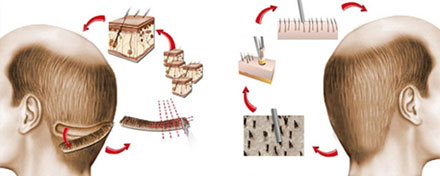
In FUT hair transplant surgery, a strip of tissue with hair is removed by surgically cutting with a scalpel blade and then meticulously preparing grafts of rectangular cross section for hours.
In FUE hair transplant surgery, cylindrical follicular units are extracted by a motorized automatic Harvester with a tiny micro punch. The follicular units gets collected in a canister automatically by vacuum and are stored in a Bio-Saline Fluid (feature only available with FUETOR system)
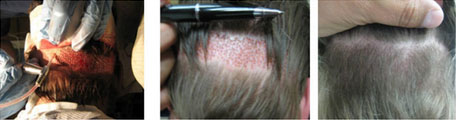
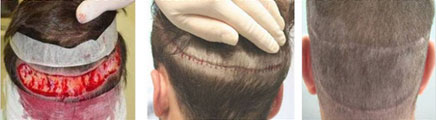
Will I get scar marks on my head?
How does my scalp look after implantation?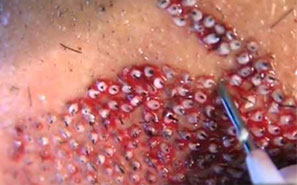
For better growth, follicular units are are implanted with 1-2mm projecting out from the scalp.
This after implantation the scalp looks like like tiny pimples on the implanted site .
(see picture). The extra tissue will shed along with the old hair after 2-3 weeks on its own.
How does FUETOR work during harvesting and implantation?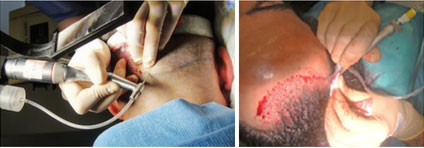
In FUETOR, Harvesting is done in very clean way with out touching the hair graft either with hair or with forceps/tweezers as Shown in the picture. Thus there is no chance of trauma to the follicles. In addition to this, follicles are stored in a Bio-Fluidic bath to retain its Biological properties alive for better growth.
Similarly, implantation is also done with out touching the follicular unit And each follicular units are precisely and atraumatic ally placed on the scalp.
How do I know the type of hair loss?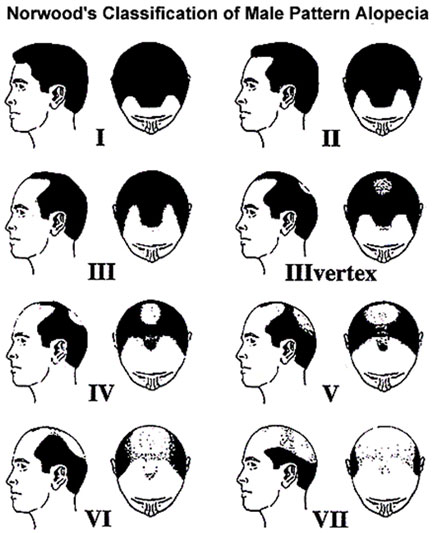
Norwood classification of male pattern alopecia
Class I represents an adolescent or juvenile hairline and is actually balding. The adolescent hairline generally rests on the upper brow crease.
Class II indicates a progression to the adult or mature hairline that sits a finger’s breath (1.5cm) above the upper brow crease, with some temporal recession. This also does not represent balding.
Class III is the earliest stage of male hair loss. It is characterized by a deepening temporal recession.
Class III Vertex represents early hair loss in the crown (vertex).
Class IV is characterized by further frontal hair loss and enlargement of vertex, but there is still a solid band of hair across the top (mid-scalp) separating front and vertex.
Class V the bald areas in the front and crown continue to enlarge and the bridge of hair separating the two areas begins to break down.
Class VI occurs when the connecting bridge of hair disappears leaving a single large bald area on the front and top of the scalp. The hair on the sides of the scalp remains relatively high.
Class VII patients have extensive hair loss with only a wreath of hair remaining in the back and sides of the scalp